2026 Staffordshire Games Institute Welcome Week talk
I was asked by the head of the Staffordshire Games Institute, Chris Headleand, to give a 10 minute talk to our incoming freshers from our games programmes. We run quite a few of these, in game programming, design, and art, covering the full range of roles needed to make games. There would be around 500 students in the room, because that's how many we have (!).
“About the impact of games on society. A bit of a motivational piece,” said Chris. “Oh, yeah, okay. I should be able to do that,” I said.
I sort of forgot the first part, and there was a lot of discussion about generative AI in our student discord, so I made it a bit about that. It ended up doing the bit I forgot anyway, so that was lucky.
I got lost a couple of times in the actual speech because I was getting a bit passionate as I gave it. But I also wanted to save it for posterity, and thought I would post it because maybe there's another university starter out there in games that needs to hear (/read) this. I've edited it slightly to reflect some of the notes I took last minute and to pop a few links in to the more obscure games I reference.
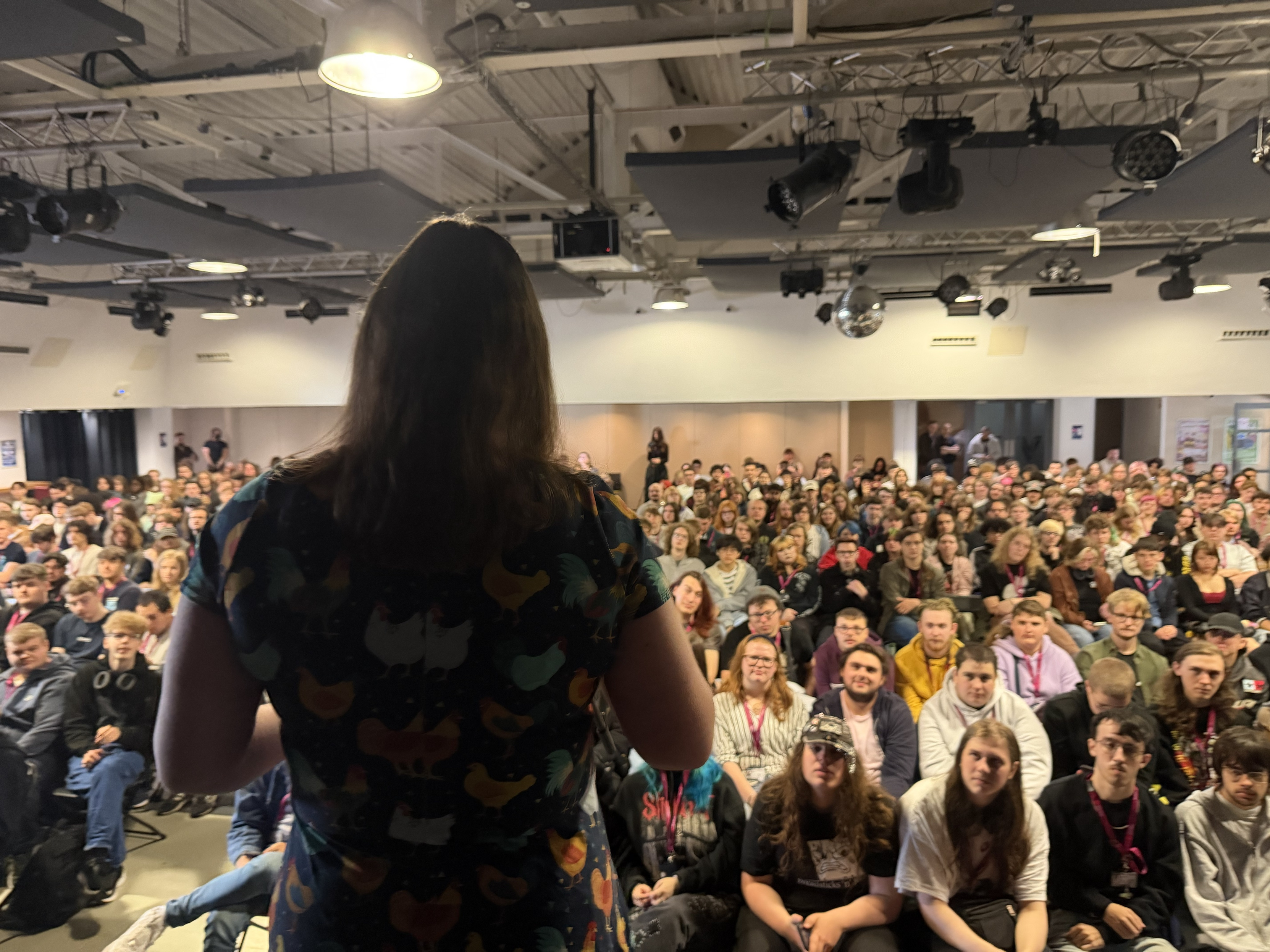
Good morning everyone!
So I’m a technology ethicist, and normally when I get up in front of crowds like this it’s to talk about the doom and gloom of technology. Today I get to do something different, which is wonderful, I get to welcome you to the next chapter of your life!
But I mean, there may be some of you who are worried about technology, especially generative AI, coming into this new chapter of your life. The games industry is in flux. Everyone’s concerned about money, and technology, and jobs, but nobody seems to be doing much about it. And your worries are very valid!
But you are also filled with excitement and hope, because here you are in the best games department in the UK, and for the next few years, you’re going to be making games. Making games! How incredible is that!
Games are the ultimate conjunction of art and technology. They have the ability to change peoples’ minds. They can immerse someone in a completely different experience. They can give us space to experiment with different decisions, with possible futures, with how we express ourselves, with finding our own identity. We can use them to tell stories, share experiences, and make political and moral statements to the world. They can challenge our ways of thinking, our behaviours, our approach to life, our relationships with others. They are actively engaged with, not passively consumed. Games are powerful.
And you know what? These human experiences are things that generative AI is very bad at. Sure, it can reflect the data that has been fed into it, but it can never conjure up a new way of thinking about what it is to have an experience. To see, feel, hear, taste, smell the world. To empathise with human – and non-human – experiences. To feel joy and suffering, and everything in between. This is where our very human creativity is so powerful and unique to every single one of us. We all have something we can express, and we all want to make games.
We want to connect with people. It’s part of our human drive to do that. We are social creatures who need social connections. We tell stories as part of those connections, whether it’s just about our day, or how the weather is. Games are ways to connect with people, whether it’s getting together with friends to play Big Walk, getting annoyed with stinky bugdivers in Helldivers 2 or League of Legends feeders, empathising with someone’s grief in games like That Dragon, Cancer, or experiencing what it might be like to have Obsessive Compulsive Disorder in The Halting Problem. It might be a huge narrative adventure like Baldur’s Gate 3 that immerses you in different kinds of human (and non-human!) relationships, and uses those to explore experiences you might not ever have in your own life. It might be the in depth lore of Dragon Age games that span centuries of time in those worlds. These are all connections – humans speaking to humans – humans wanting to tell other humans stories that are meaningful to them in some way. Even the potentially toxic interactions with angry players are still human connections that make you feel something! (though maybe not the best of our humanity)
When you make games, they don’t have to be deep and meaningful, but whatever you make, someone will engage with it, and you have space to express yourself, showing off your skills at procedural generation, guiding a player through environmental storytelling, building a level that challenges people in all the right ways. You may have a big community that builds around your game, or it might just be played by 2 friends and your little sister. It might be a silly game about chickens or a complex, thoughtful visual novel about relationships. What I’m saying is – anything you make, you, yourself, is a creative expression of your skills, background, values, and understanding about the world. And that’s to be celebrated in a world where we seem to be increasingly reliant on technologies designed to smooth things out, to make things bland and boringly acceptable to an algorithm that looks for the most mid response to a prompt.
So if you’re worried about technology, channel that concern into being as creative as possible, to embracing your humanity and expressing that through your skills, ideas, interests, and projects. Don’t just give over to the algorithms. Continue to push back against boring blandness by developing your critical thinking skills, by trying new things, by failing and learning from your mistakes. Because that’s the way we humans do things, and valuing the humanity in our games is how we get through this together.
So that is my plea to you, fellow humans with very different experiences from my own. Be your authentic selves, and be them as strongly as you can. University provides the perfect space to do this, to try things, to fail, to try again, and to find your path through an uncertain world, knowing you have a safety net with people around willing and able to help you through.
I remember my first day at university, back in a different century, in a different country, going in to my first class, absolutely terrified. Had I made the right choice? Would my program be for me? What if everyone else was better than I was? What if I fail? I wanted to make my parents proud. I wanted to show all these guys who had been programming since they were 11 years old that I, one of around 3 women in a 300 strong computer science program, could keep up. This was despite the fact that I’d never programmed at school because computing for girls was learning to touch type and setting out leaflets for school fetes. So yeah, I was terrified. And I had to learn quickly, and I failed, and I tried again, and again… and eventually I passed, and somehow at the end I graduated with a first class honours degree (and went on to do a PhD and eventually become a professor!). But that was just the mechanics of it. Along the way I made friends, I did some very stupid and some very clever things, but the best thing I did was I found my people. And we’re still friends today, some ahem years later, and in multiple different countries from where we started.
I wanted to tell you that story because there are probably some of you here who are super confident, you know exactly what you’re getting into, and you have the existing portfolio and skills to match. And you’ll be great. But there might be some of you who have the imposter syndrome I did, eating away at you making you wonder the same questions I had. So this bit is for you. Show up every day. Put the work in. If you fail, have a good cry, then get up and try again. Find some people who show up for you and lean on them for support. Go and join societies. Do some volunteering. Do a game jam or 3. Find your people, because these are your people.
And hey, you, with the portfolios and the prototypes and the artstations and the linkedin connections, you should do these things too. Because you never know what life might hand you, and even if everything goes right, you still just might find the people who you start an indie studio with, or who give you that job, or who you work with in group projects. And meeting people, working together, and sharing your stories outside of formal learning spaces is a wonderful way to make connections that last a lifetime.
So we find ourselves in a world that increasingly empowers money and technology over humanity. And I hope that I’ve shown you that there is still hope for the future, and that you are going to be a very important part of this future, because of the power that games have to help tell very human stories and to connect humans together with very human experiences. You won’t be alone on this journey, you’ll have all these people you see around you coming with you. And the people up on this stage will be there to help you pick yourself up if you try something and it doesn’t quite work. That’s what we’re here to do. So not so much more doom and gloom about technology – we may have to live with it, but we don’t have to be controlled by it. By retaining our humanity: our ability to critically think, to create, to try things, to make and learn from mistakes, to build, to empathise and to connect with others, we are so much more than even the most human-seeming AI model can even pretend to be.
So to finish off, embrace your humanity, be yourself, be creative, think critically, and remember that these people here around you – these are your people. We all want to make games, and games are incredible things to be able to make.
Follow this blog on the Fediverse: @cflick@blog.liedra.net Want to comment? Copy me in: @CatherineFlick@mastodon.me.uk